
What Florida Medicaid Really Does With Your Retirement Accounts


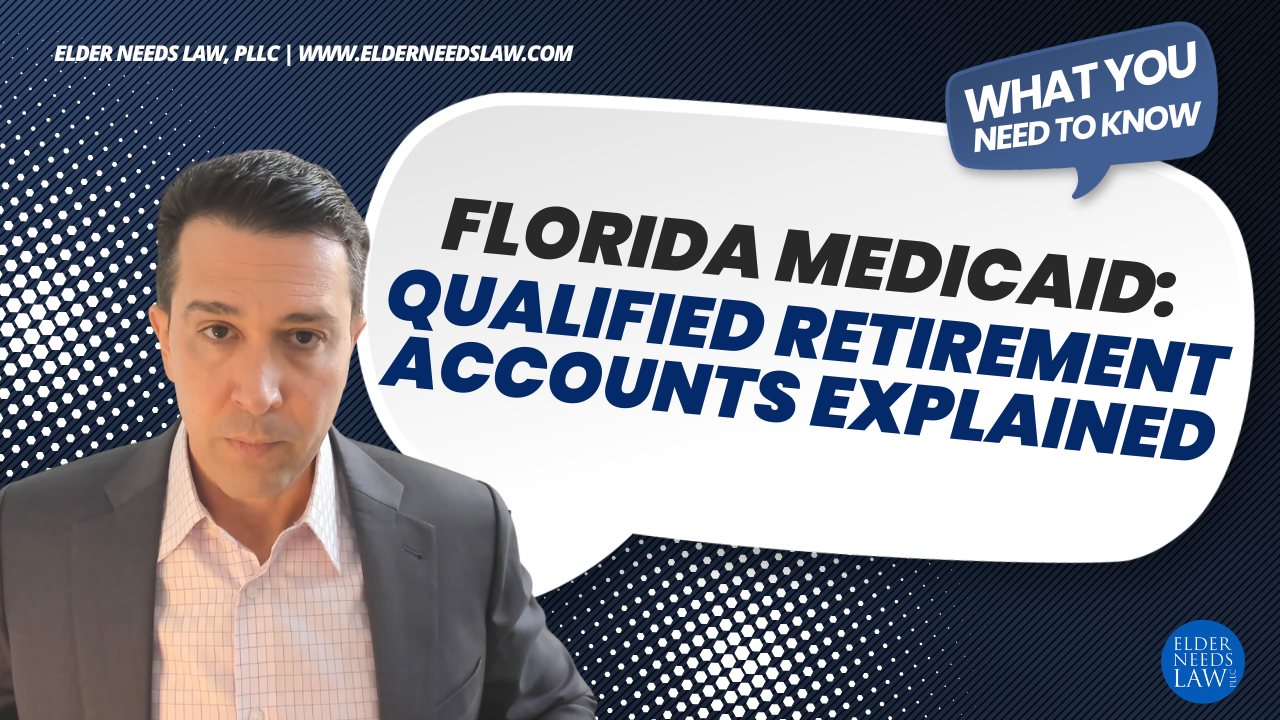
Your IRA or 401(k) might be worth hundreds of thousands of dollars — and it doesn't have to disqualify you from Medicaid long-term care benefits.
By Jason Neufeld, Board-Certified Elder Law Attorney | Managing Partner, Elder Needs Law · Serving All of Florida
When a Florida family comes to us worried about paying for a loved one's long-term care, one of the first things we look at is retirement accounts. IRAs, 401(k)s, Roth IRAs — these are often a family's most valuable asset outside of their home. And here's the thing most people don't realize: Florida Medicaid treats these accounts very differently than a regular savings account or investment portfolio.
That difference can mean the protection of hundreds of thousands of dollars. It's one of the most powerful tools in Medicaid planning, and it's one you absolutely need to know about before making any decisions.
Which Accounts Are We Talking About?
When we say "qualified retirement accounts," we mean anything the IRS recognizes as such. The most common ones we see are traditional IRAs, Roth IRAs, 401(k)s, 403(b)s, and SEP IRAs. If it's an IRS-qualified retirement account, it falls into this category. The rules we're about to walk through apply to all of them — and the implications are significant.
The Default Rule: Retirement Accounts Count Against You
To qualify for Florida Medicaid — whether that's for care at home, an assisted living facility, a nursing home, or the PACE program — your countable assets generally have to be at or below $2,000. By default, money sitting in a qualified retirement account counts toward that limit.
That's a problem when your IRA holds $300,000.
"The principal value of the account — which can be hundreds of thousands of dollars, a million dollars, whatever the case is — is not counted against your $2,000 limit. That's incredibly important."
The Exception That Changes Everything: Regular Distributions
Here's where Florida's approach gets interesting. Under Florida Medicaid rules, if all of your qualified retirement accounts are paying out regular distributions, the state stops counting the principal balance as a resource. The account is effectively excluded from that $2,000 asset limit.
To be clear about what this means in practice: if your IRA has $400,000 in it and it is making regular distributions, that $400,000 does not count against your Medicaid eligibility. The distributions themselves become part of your income picture — which is a separate conversation, and may involve a qualified income trust (also called a Miller trust) — but the principal is protected.
Important: Florida Medicaid does not require distributions to be "required" minimum distributions (RMDs). Each account simply needs to be making regular distributions. This opens up options for people who wouldn't otherwise have to take money out.
Three Situations Where This Gets Complicated
1. Clients over 73 — usually no action needed
If you're 73 or older, federal rules already require you to take Required Minimum Distributions (RMDs) from most qualified retirement accounts. Because you're already taking regular distributions, you generally satisfy the Florida Medicaid requirement automatically. No extra planning steps needed on this front.
2. Roth IRAs at any age
Roth IRAs are a special case. Federal law does not require distributions from a Roth IRA — ever. So if someone has a Roth IRA sitting untouched, Florida Medicaid will count it as an asset. We have to start taking distributions from it even though there's no legal requirement to do so. We help clients calculate a reasonable distribution amount to satisfy the Medicaid rule while being mindful of their overall financial picture.
3. Traditional IRAs for clients under 73
If you have a traditional IRA and you're not yet at the age where distributions are required, that account is just sitting there. Medicaid will count it as an asset. To protect it, distributions have to start — and that means accepting some additional income tax that year. In some situations, if you're under 59½, there may also be an early withdrawal penalty from the IRS.
Florida Medicaid doesn't factor any of that in. The rule is simply: is the account making regular distributions? If yes, the principal is excluded. If no, it counts against you. We help clients weigh that trade-off carefully, because in most cases, starting distributions is far preferable to having to cash out the account entirely to get below the $2,000 asset limit.
What About Regular Investment Accounts?
This is worth saying clearly: the distribution strategy only works for IRS-qualified retirement accounts. A standard taxable brokerage account, a regular savings account, a CD — none of those qualify. For those assets, we use other legal tools to help protect them. There are good options available, but they work differently. If you have a mix of qualified and non-qualified assets, the planning process will address both, just through different means.
A Quick Summary of How This Works
- Florida Medicaid has a $2,000 countable asset limit for most long-term care programs.
- Qualified retirement accounts (IRAs, 401(k)s, etc.) count toward that limit by default.
- If every qualified retirement account is making regular distributions, the principal is excluded from the asset count.
- The distributions count as income — separate rules apply and a Miller trust may be needed.
- This applies to Roth IRAs (no federal distribution requirement) and younger clients (no RMD age yet) — distributions can and should be started to satisfy the Medicaid rule.
Jason Neufeld's Book
Medicaid: Make Someone Else Pay for Some of Your Long-Term Care Expenses
A straightforward guide to Medicaid planning in Florida — written for families, not lawyers. Available on Amazon: https://www.amazon.com/Medicaid-some-your-long-term-expenses/dp/1513634712
Don't Make These Decisions Without Legal Guidance
The rules around Medicaid and retirement accounts in Florida are specific, and the consequences of getting them wrong — cashing out unnecessarily, missing the distribution requirement, triggering a penalty that didn't need to happen — can be significant. Every situation is different. The right distribution amount, the timing, the income tax implications, whether a Miller trust is needed: these are things that need to be worked through carefully based on your specific accounts and circumstances.
This is exactly what we do at Elder Needs Law. We work with families across Florida — at home, in assisted living, in nursing facilities — helping them protect the assets they've spent a lifetime building, without having to sell the house or wait five years to qualify.
Ready to talk through your situation? We serve families throughout the entire state of Florida. A consultation is the right first step.
Website: https://elderneedslaw.com Medicaid Planning: https://medicaidplanninglawyer.com/
This article is for informational purposes only and does not constitute legal advice. For guidance specific to your situation, please schedule a consultation with Elder Needs Law.